
History

Ninth Grade Integrated Course Requirement

Ninth grade students take Humans in the Natural World which integrates English, Social Science and Natural Science.

Humans in the Natural World (three credits)


Using the tools of these three disciplines, this three-trimester course begins by asking “How Do We Know What We Know?” Starting with things we can observe locally, we will expand to connect to the global community. Students will be expected to collaborate with each other, make connections
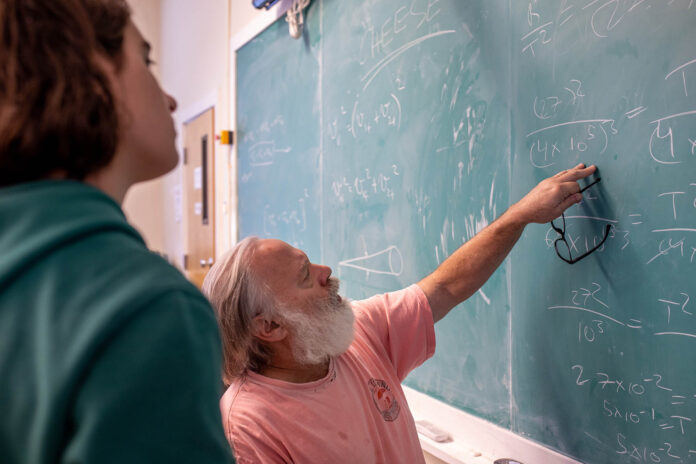
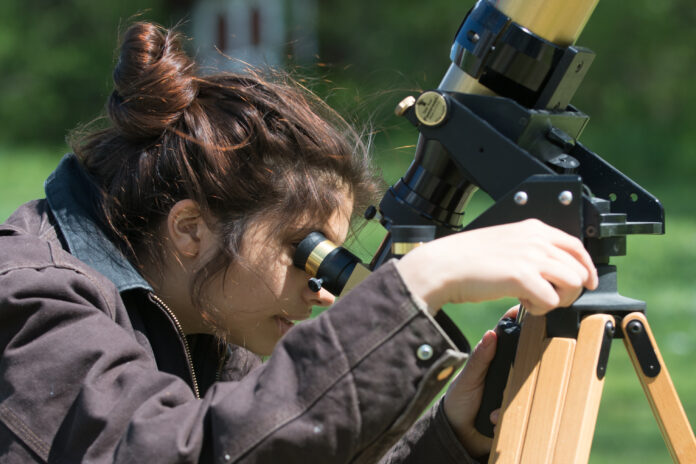
and synthesize information about their world from historical, scientific, artistic and literary sources. Each student will undertake several long-term projects, including detailed studies of a plot of land, a country, and a commodity. Students will read novels, poetry, and both primary and secondary sources in all the disciplines. Ultimately, our 9th graders will hone their skills in analytical and creative writing, oral presentation, collaboration, research and analysis. They will also learn the habits of reflection, self-evaluation, perseverance, and practice. Throughout they will demonstrate their skills and understanding through presentations, experiments, Wiki creation, writing and teaching. After completion of the integrated course, Putney students will be expected to accurately sketch the world around them, critically observe and analyze their environment, collect and use GIS (Geographic Information Systems) data, write in both analytical and imaginative forms, synthesize scientific and historical facts into meaning and be fearless enough to embrace uncertainty, ambiguity, and the benefits of failure. Students will earn credits in science (.5 biology .5 earth science), history/ social science (1.0), English (1.0). In addition they will learn some basic tools and vocabulary of economics, GIS,
data analysis, and political science, as well as the rudiments of epistemology. Mathematical thinking will be an integral part of our study.
Close

Tenth Grade Course Requirement

Tenth grade students take History of the Modern World which focuses on western society and culture.

History 10 • History of the Modern World (full credit)

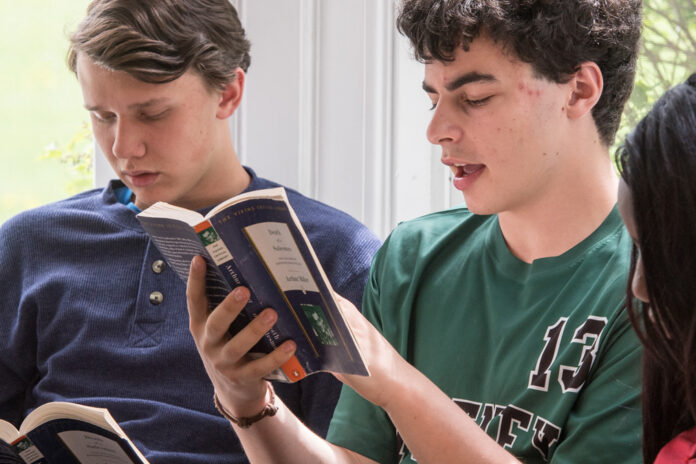
This course focuses on the major themes in the development and “modernization” of western society and culture, and its relationship to the world at large. Students analyze primary source material to study the spiritual base of medieval society, the individuality of the Renaissance and Reformation, the growth of constitutionalism from the Anglo-Saxon Witan through the twentieth century, the process of industrialization and its early critics, the development of nationalism and the impact of World War I and II for humanity. The readings range from textbooks and documents to historical novels. Student assignments include tests, papers, library research projects, oral presentations and formal debates. Texts: Sherman and Salisbury, West in the World; Machiavelli, The Prince; More, Utopia; Remarque, All Quiet on the Western Front; Wiesel, Night; and other selected other readings.
Close

Eleventh Grade American Studies Requirement

These courses are required for juniors in lieu of 11th grade English and U.S. History to provide richer exploration of American society, culture and history.

American Studies Grade 11 (1.5 credits)


This course is a year long interdisciplinary course that asks the fundamental question: “What does it mean to be an American?” The course is arranged around a series of thematic explorations including nature and the wilderness; democracy and American political thought; class identity and formation; slavery and its legacy, ethnicity and identity; consumerism and American economic growth. Courses are taught by teachers in both the English and History departments, and readings from both disciplines provide the essential backdrop for dynamic class discussion and exploration. Finally, students are expected to design their own thematic unit of study as a final assignment in the class. Fundamental skills of independent thought, reading for meaning, oral expression, and creative and analytical writing are central to the class.
Close

Writing and Research: Humanities Thesis (half credit)

This course meets for one trimester and is taught by members of the English and History departments. The primary goal of this course is to facilitate the writing of a substantial research paper. Students learn the essential skills of thesis development, interpretation, and analysis. A significant amount of time is devoted to the study of rhetoric and research methodology.
Close

Twelfth Grade History Electives

Twelfth grade students are permitted to take any of the following electives.

History 12 • African Studies (half credit)

African Studies will focus on decolonization in Southern Africa. The aim will be to better understand the challenges of building African economic and social structures in the wake European control and exploitation. The region provides a variety of models and experiences. The course will be divided between a topical overview and independent student projects developing an area of special interest.
Close

History 12 • The Middle East Cauldron (half credit)

Today, the Middle East remains a focal point of cultural misunderstanding and conflict. This course seeks a greater understanding of this complex and volatile region. The course begins with a look at the political, economic, cultural and religious influences in the region, from the collapse of the Ottoman Empire to the present, using both primary and secondary sources. Later the course will consider some selected topics from the history of the region, the Sunni Shiite split, and the growth of Islam. The course will conclude with an independent project. Either Economics or Latin American History will be taught depending on enrollment.
Close

History 12 • Introduction to Economics (half credit)

The term economics is derived from the Greek “rules of the household.” In this course we look at the way in which economics governs our lives, homes, political, and international institutions. We will consider the way in which economic actors (ourselves included) make decisions. The course begins with a brief survey of basic economic concepts and terminology. We then look at a series of subjects: the power of markets; incentives and economic behavior; game theory; globalization; international economics; government and the economy; business cycles and the mortgage crisis; environmental economics; and market forces. Articles from the newspaper and news magazines will serve as the backdrop for the class. The class concludes with a research assignment in which students design and produce an independent work.
Close

History 12 • Latin American History (half credit)

This course introduces some of the major forces and events that have shaped Latin America: conquest and colonization, economic imperialism, racial and ethnic integration, the church, migration, trade, and the environment. Sources include literature, art, film, historical essays, political documents, economic data, and current events to help us make sense of Latin America. Students will write two country-specific papers, one of which can involve creating an alternative project that is a non-writing research-based assignment (for example, writing a Mexican folk ballad, knitting an Andean earflap hat, or creating a Brazilian cookbook). Students should leave the class with a greater appreciation for the richness, complexity, and diversity of the region.
Close

History 12 • Balkans Seminar (half credit)

Balkans explores the rich, colorful, and tragic history of a region with one foot in Europe and the other on the far side of the world. The Balkans burst into world news with the breakup of Yugoslavia and the ensuing massacres, and then faded almost as rapidly. Our study begins with an overview of several Balkan countries from Josip Tito’s remarkable unification of a non-aligned Yugoslavia, to the connections between current problems and old legends from “Vlad the Impaler” to the “Pied Piper of Hammelin.” The central reading for the course will be Robert Kalpan’s fascinating study, Balkan Ghosts. The course will conclude with a written student project on a related topic of their own choosing.
Close

History 12 • Unity and Disunity: The Han Synthesis as a Window to Chinese History (half credit)

This course examines the ebb and flow of unity and disunity throughout ancient Chinese history and approaching the modern age. What forces caused China to band together in empire? What forces forced it apart? We will examine the Han Synthesis of Confucianism and Legalism as a central point in Chinese history, and use this as a window into issues of philosophical and religious harmony or disarray. We will examine political theory, human movement, and cultural and social norms, with an eye for how they have influenced Chinese dynasties and states from ancient to modern times. Through an examination of texts, art, literature, and artifacts, we will build an understanding of the forces that have determined Chinese history.
Close

History 12 • Comparative Religions (half credit)

This course seeks to understand the traditions of religious belief and the nature of the divine in history and across cultures. The course will emphasize religious texts in their historical and cultural context. Writing will include both analytic and personal response. Readings include Huston Smith, The World’s Religions; The Gilgamesh Epic; Herman Hess, Siddhartha; selections from the Bagavad-gita, the Old and New Testaments, Dante’s Divine Comedy, Dostoevsky, the Koran, Rumi, and the Tao Te Ching.
Close

History 12 • Sociological Impacts of Food (half credit)

“Tell me what you eat and I will tell you who you are.” (Brillat-Savarin) Food is an ever-present part of our daily experience and a medium through which we can examine our individual and collective heritage. In this course, food, an essential human need, becomes the basis for interdisciplinary study. The course is broken into several areas: Food and Meaning; Food and Ethics; Food and Justice; and, lastly, Food and Culture. As a humanities course, we will take on each unit through a variety of disciplines including anthropology, art, literature, psychology, religion, politics, ecology, economics, psychology and history. In addition, our class will involve experiential activities, many of which include cooking or preparing meals.
Close

Elm Lea Farm, 418 Houghton Brook Road, Putney, Vermont 05346-8675
802-387-5566 (main) or 802-387-6219 (admission) 802-387-6278 (fax)
info@putneyschool.org