

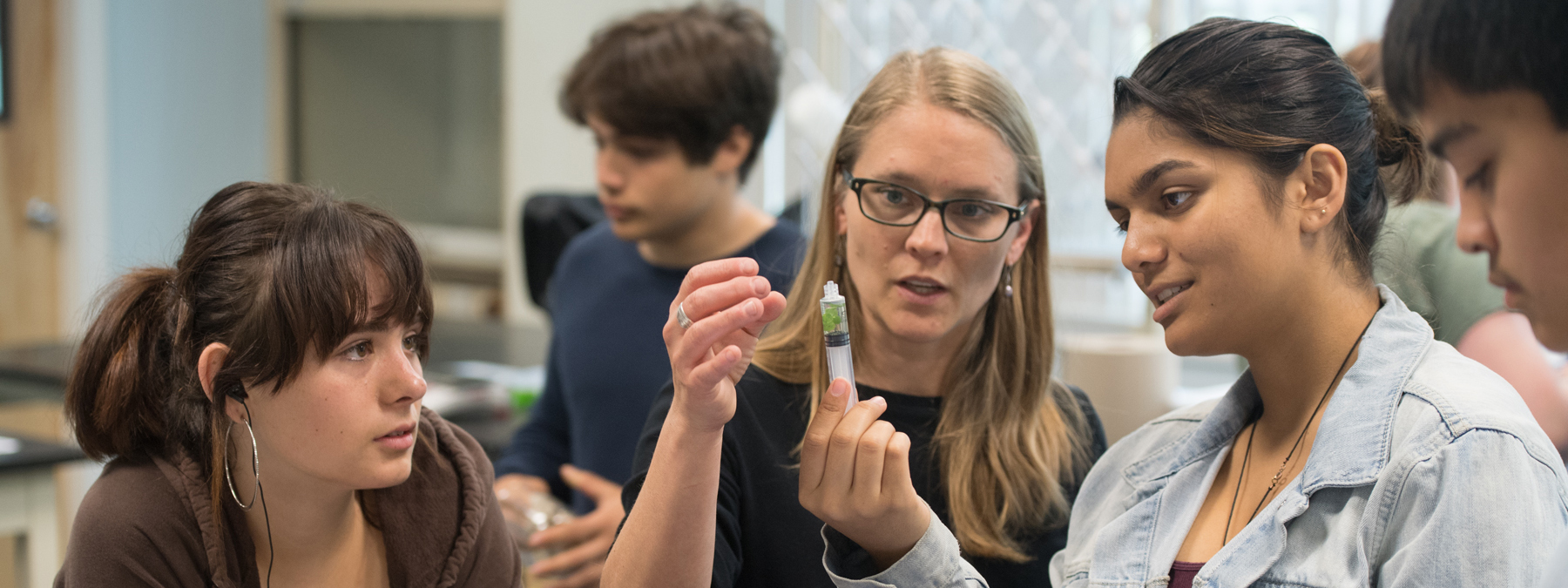
The study of science at Putney revives, instills and encourages curiosity about the natural world by equipping students with the habits of mind needed to ask and answer questions using the scientific method. Courses introduce fundamental biological, chemical and physical principles through active inquiry, experimentation, direct instruction and exercises in problem-solving. Advanced tutorials in the sciences are available and common. Upon graduation, students will have developed an understanding of essential methods and content sufficient for lifelong learning, responsible citizenship and for further study of science at the university level.
Anatomy and Physiology 1
One Term | Biological | Lab
How do our bodies keep us alive? Together, anatomy and physiology provide us with an intimate understanding of the form and function of the body’s tissues and organs. Anatomy and Physiology 1 focuses on identifying structures and discovering how they enable the human body to accomplish remarkable tasks every second of every day. After developing a working knowledge of cellular function, histology, and homeostasis, students explore four systems of human anatomy and physiology in depth: skeletal, muscular, cardiovascular, and respiratory. In each section, students learn relevant anatomical terms, perform laboratory dissections (on animal parts), and design physiological tests to observe processes in action. Case studies are used to provide context for what happens when systems do not maintain homeostasis properly (i.e. disease and injury). Students keep thorough lab notebooks, write lab reports, build models and other visual representations, and create presentations based on their understanding of various body systems.
Prerequisite: Chemistry and Microbiology
Anatomy and Physiology 2
One Term | Biological | Lab
The second term of Anatomy and Physiology builds on the foundational knowledge gathered in the first. Students explore three more body systems in depth: the nervous, endocrine, and lymphatic/immune systems. They learn critical anatomical terms, connect form with function through a study of physiology, and develop a deep understanding of how these systems work together to keep us alive. Relevant dissections, labs, and clinical scenarios are used to refine and expand their understanding. Students collectively select a final project to investigate; possible options include: systems that were not covered (digestive, urinary, and/or reproductive) or a deeper study of how anatomy and physiology connect with important societal issues like drug addiction, vaccination and herd immunity, autoimmune diseases, or any number of other medical connections.
Prerequisite: Anatomy & Physiology 1
Astronomy
One Term | Physical | Lab
How do we know what we know about the universe, from nearby planets to distant galaxies? This course explores this central question through observational work, imaging, measurement, student projects, discussion, and classroom-based analysis. It hardly seems reasonable to detect an object that is by its very nature unobservable, or to claim knowledge of the composition of stars with any scientific certainty. Yet astronomers have reached many such conclusions, and this course follows their chain of reasoning. Topics to be discussed include planetary motion, stars and their life cycles, and the nature and scale of astronomical objects and the space that surrounds them. Emphasis will be placed on techniques of astronomical distance measurement. We will use our observatory to view, image, measure, and make inferences about the objects we find. Over time, we will reconcile observations made at night with knowledge developed in the classroom. One class per week will be devoted to student projects in astronomy. By the end of the course, students will know their way around the sky, have a sense of the scale of our universe, how it develops over time and the nature of the objects in it.
A chemistry background is preferred. Completion or concurrent enrollment in Algebra 2 or above is required.
Astronomy 2
One Term | Physical | Lab
Asking productive questions in astronomy through guided, independent investigation, Astronomy 2 emphasizes the practice of astronomical inquiry through self-directed work in observational astronomy, building projects, and focused readings. Students learn how to formulate, refine, and pursue meaningful research or project questions, with guidance from the instructor. As their work develops, students revisit and revise both their questions and methods in response to new observations and insights. Students design individualized courses of study based on their interests. Hands-on work may include astrophotography, telescope making and repair, or constructing physical models of astronomical systems. For students pursuing a more academic astronomy or physical science pathway, work centers on stellar properties and evolution, with sustained exploration of the Hertzsprung–Russell diagram serving as an essential organizing framework.
The course runs concurrently with Astronomy. Most work is completed independently, with discussion and feedback taking place during conference blocks, evening study sessions, and at the observatory. Instructor permission is required, as is prior completion of Introduction to Astronomy (or equivalent experience) and the ability to work independently. Prerequisite: Instructor permission as well as astronomy or equivalent and the ability to work independently.
Biodiversity and Conservation Ecology
One Term | Biological | Lab
How do we measure biodiversity and determine the best conservation strategies for our rapidly changing planet? This advanced biology elective is designed to give students an introduction to community ecology and a solid understanding of the systems which support life on earth. The course examines how ecosystems are structured by surveying plant and animal populations, nutrient cycles, and forms of symbiosis as well as how human systems and policies have impacted biodiversity around the world. Students investigate how populations grow and decline and the factors that affect biological diversity through direct exploration of ecological systems on campus and in the surrounding community. Emphasis is placed on fieldwork and participation in research and monitoring underway in our region. Class time includes discussions, habitat explorations, field labs, meetings with professionals working in the field, and presentations of fieldwork.
Prerequisite: Chemistry and Microbiology.
This course is available in alternating years. Offered in 2026-27.
Bioethics in Modern Science
One Term | Biological | Lab
How do we map the ethical boundaries of the practice and progress of modern science? Bioethics investigates the moral dimensions of scientific research and medical practices through case studies, research, critical reading and writing, discussion, and structured argumentation. Students apply ethical frameworks from philosophy and science to contemporary debates in biotech and medicine. They analyze landmark historical cases that continue to shape scientific practices as well as cases that are still unfolding. Our emphasis is on developing criteria for ethical questions in research to balance scientific innovation with human rights, social justice, and cultural values. Core topics include gene editing technology, the allocation of scarce resources such as donor organs, and end-of-life rights. At the end of the trimester, students have the opportunity to delve into a topic of their choice.
Prerequisite: Chemistry and Microbiology.
Chemistry 2: Color Extraction
One Term | Biological, Physical | Lab
What molecular structures and chemical processes enable us to extract and apply color from natural sources? This course investigates the chemistry of natural dyes and lake pigments through laboratory extraction techniques, fiber dyeing, paint production, scientific readings, and class discussions. The course begins with a targeted review of concepts such as Lewis dot structures and hydrogen bonding, and then continues with the study of organic molecules that provide color, including tannins and traditional dyes. Students investigate the chemical interactions and reactions involved in color extraction and explore intermolecular forces, pH, and redox reactions. This course requires collaboration on designing and conducting multiple experiments, as well as independent work on an application project. The curriculum incorporates plants from the dye garden, local materials, and several of the most common historical dyes. Additionally, students must connect their understanding of chemistry to historical, environmental, and socioeconomic contexts. Emphasis is placed on laboratory techniques that minimize resource waste.
Prerequisites: Chemistry and Microbiology
Offered in 2026-27
Chemistry and Microbiology
Two Terms | Biological, Physical | Lab
Life is chemistry - what we eat, what we breathe, how we live, what we are. The two halves of Chemistry and Microbiology cover different but interconnected material. The first term focuses on the essentials of chemistry—atomic theory, electronegativity, chemical bonding, intermolecular forces, reactivity, stoichiometry, and measurements of solutions—in preparation for the subsequent exploration of microbiology. During the second term, students apply their understanding of chemistry to biological macromolecules to understand how cells communicate and replicate, transfer energy, relay information from generation to generation, and how genetic mutations drive adaptations and disease. Students develop laboratory skills as well as the ability to design and implement a protocol to answer discrete biochemical questions. Students will become proficient in gathering, organizing, describing, and analyzing data. This course fulfills 1 laboratory science (0.5 physical and 0.5 biological).
Complex Systems: Agroecology
One Term | Biological | Lab
How do we build farming systems that are ecologically, economically, and socially sustainable? Agroecology explores the sustainability of agricultural systems through farm visits, fieldwork, scientific reading, discussion, and project-based research. Using the farm on campus and other local farms as living laboratories, students investigate how farming practices shape the land, local economies, and communities over time. The course combines ecological study (soil health, plant growth, and nutrient cycles) with contemporary analysis of farming in our region. Readings draw from scientific texts, peer-reviewed journals, agricultural histories, and current debates in food and farming. While the course is tailored to student interest, students have the opportunity to examine topics such as climate change resilience, organic versus conventional systems, GMOs, rotational grazing, permaculture, water conservation, and pest management. Final projects invite students to synthesize ecological science with social and economic perspectives, proposing pathways toward resilient agricultural futures.
Prerequisites: Humans in the Natural World and Chemistry and Microbiology, or permission of the instructor.
Engineering and Design
One Term | Physical | Lab
How do we build objects in a timely fashion that clients actually want and need? How do we communicate meaningfully with clients both to understand their needs and to explain how they fit into the design and engineering process? In this course, students use the engineering and design process to solve problems of increasing difficulty. The course culminates with students working in teams to solve a real-life problem for a real client. Students use engineering and scientific concepts in the solution process. In addition, students are required to document their work using standard engineering and scientific rubrics. In designing prototypes/solutions, students learn skills used by mechanical and chemical engineers, such as simple mathematical analysis, 3D printing, CAD, circuit design, and simple solution chemistry. Strong collaboration skills are necessary for the successful completion of this course.
This course is open to students who have successfully completed algebra 2, precalculus A, and chemistry, or who have the instructor's permission.
Environmental Philosophy
One Term
How do we approach, reflect upon, and discuss some of the most pressing environmental issues, especially in our seemingly polarized world? How do we open a dialogue with those whose views are radically different from our own? Environmental Philosophy begins with a foundational study of environmental philosophy, ethics, and argumentation & rhetoric and then focuses on specific issues such as climate change, economics, and climate justice. Students learn the fundamentals of critical thinking including the nature of claims, arguments, reasoning, evidence and fallacies as well as the basic theories in environmental ethics including duty-based ethics, utilitarianism, rights theory, and the ethics of care. The course also involves an in-depth study of complex systems theory including complex v. linear systems, complex adaptive systems, network theory, and self organization within systems. Ultimately, students use these skills and knowledge to deconstruct how various groups of people discuss climate change through the analysis of dialogue and argumentation. By the end of the course, students will be able to both analyze rhetoric and construct effective arguments related to climate change and other controversial topics. Science or humanities credit.
Field Ornithology
One Term | Biological | Lab
How do we identify and understand birds through their field marks and sounds? In Field Ornithology, students learn field strategies for identification, study how birds use various habitats, and investigate the physics and physiology of sound as well as the mechanics of recording sound. Students build their own microphone systems to record and then visualize sound through sonograms (spectrograms) and learn about how these sonograms can act as a distinguishing feature for identifying bird species. In the field, students spend time observing, listening, and keeping a detailed field notebook about the species and habitats they observe. Other field work involves creating a sound map of campus during spring migration to understand how habitat can predict the presence of bird species. The course culminates in individual, student-designed experiments using sound data as a set dependent variable and an independent variable of their choice. Coursework includes both indoor and field lab components connected to physics, biology and ecology.
10th grade students may sign up with permission from the instructor.
Independent Topics in Life Science
One Term | Biological | Lab
This course is designed to give highly motivated and independent students the opportunity to pursue scientific or technological questions of their own design, or for students to take on a challenge such as entry in a science contest. This section gives students the chance to explore within the life sciences, including topics in chemistry, advanced biology, ecology, forensics, etc. One component of the course is continuous communication and collaboration with other students in the class, regardless of their respective areas of study.
To qualify for enrollment, students must submit a description of their proposed topic of study to the science department for approval. Students considering this course are expected to discuss their eligibility with the instructor before submitting a proposal. Proposals which overlap significantly with courses currently being offered will not be considered. Offered in Spring. This course is open to students at any grade level. There are no prerequisites other than the ability to work independently.
Independent Topics in Physical Science & Engineering
One Term | Physical | Lab
This course is designed to give highly motivated and independent students the opportunity to pursue scientific or technological questions of their own design, or for students to take on a challenge such as entry in a science contest. This section gives students the opportunity to focus on questions primarily in the domain of the physical sciences including engineering. These divisions are not always well defined and can make selection of the course seem unclear. In these instances, students should discuss their ideas with the science department chair. There may be some cross-over with the section on life science—a student interested in a bio-medical pump took the course because her problems were centered on the pump mechanism. One component of the course is continuous communication and collaboration with other students in the class, regardless of their respective areas of study.
To qualify for enrollment, students must submit a description of their proposed topic of study to the science department for approval. Students considering this course are expected to discuss their eligibility with the instructor before submitting a proposal. Proposals which overlap significantly with courses currently being offered will not be considered. Offered in Winter. This course is open to students at any grade level. There are no prerequisites other than the ability to work independently.
Molecular Genetics 1: Classical Genetics & Biochemistry
One Term | Biological | Lab
How has the genetics of inherited characteristics been developed and understood over the past 150 years in Western science, and how have applied algebra, statistics, and probability underpinned this understanding? This computation-focused, advanced biology elective covers genetics in depth from Mendel all the way through gene expression in development and throughout life. Topics covered include the Central Dogma, Evolution, Phylogenetic trees & Classification, Mendel, and the Mathematical Models involved in Monohybrid & Dihybrid crosses, Three-Factor Crosses, Chromosome Mapping, Mutation and Mutation Rates, Chi-Square Analysis, and Population Genetics. In addition, we touch on Epigenetics, Gene Expression & Regulation, Plasmid Construction, Bacterial Transformation, Cloning, Genetic Analysis, and the underpinning Biochemistry. Students are responsible for conducting one laboratory experiment per week and are expected to report on that shared experience through a weekly lab paper. This course is challenging but a lot of fun. Strong collaboration skills are necessary for the this course.
The curriculum is deeply rooted in math and chemistry; students must have successfully completed both Algebra 2 and Chemistry & Microbiology or received permission from the instructor. The hope is that students taking this course will have had an introduction to genetics in previous courses.
Molecular Genetics 2: Modern Genetics and Organic Chemistry
One Term | Biological | Lab
How do we apply the tools of classical genetics to modern genetics problems? Modern Genetics & Organic Chemistry is the second term of the molecular genetics course series, and it is more lab-focused than Classical Genetics & Biochemistry while building on the skills developed there. The curriculum covers a range of topics, including gene expression, gene regulation, genomics, population genetics, genetic analysis, the use of molecular genetics techniques to tackle disease, and genetic algorithms, databases, and coding. Students learn various molecular biological techniques, including DNA isolation, PCR, transformation, and sequencing. We also touch on the meanings of genetic citizenship. Students are responsible for conducting one laboratory experiment per week and are expected to report on that shared experience through a weekly lab paper. This course is challenging but a lot of fun. Strong collaboration skills are necessary for the successful completion of this course.
Students must have successfully completed Classical Genetics and Biochemistry (Mol Gen 1), Algebra 2, and Chemistry, or obtained permission from the instructor before enrolling in this course.
Physics
Two Terms | Physical | Lab
How do we use mathematics and experimentation to make predictions about behavior in the physical world? Physics explores this central question through sustained work in experimental design, quantitative problem-solving, computation, estimation, scientific writing, and discussion. Students investigate familiar physical phenomena by deriving equations to make predictions and then designing experiments to test those predictions. The course introduces core topics in classical mechanics—including kinematics, Newton’s Laws, momentum, and energy—before moving to rotational motion and foundational concepts in electricity and magnetism. It concludes with a brief survey of modern physics.
While Physics is best taken alongside Precalculus or Calculus, two years of Algebra is required.
Physics 2: Electricity & Magnetism
One Term | Physical | Lab
This course introduces electricity and magnetism through the unifying idea of fields and the energy they store. Beginning with gravity, students explore what it means to escape a field and use the work-energy theorem to develop the language needed for electric phenomena. Qualitative experiments with charge lead naturally to Coulomb’s law and the definition of the electric field. Through symmetry and Gauss’s law, students discover how electric fields behave in space, why conductors shield, and how these ideas make possible the measurement of the electron’s charge in Millikan’s experiment. The course concludes with the Lorentz force and the motion of charged particles in magnetic fields to find the mass of the electron.
While the curriculum focuses on conceptual understanding and the connections between gravity, electricity and magnetism, basic skills in calculus and physics are required.
Physiological Ecology
One Term | Biological | Lab
What geologic and ecologic forces shaped the fields and forests of New England? Physiological Ecology uses The Putney School’s 320 acres of forest to understand the distribution, adaptations and interconnections of organisms in a New England wooded ecosystem. In addition to learning about plant physiology, students hone field observation skills through careful identification of the most common plant and tree species living in our forests, use field data to differentiate and delineate forest types, and investigate local geologic history, soils, natural and human disturbance histories, and current stressors (climate change, acid rain, pests, etc.). Through first-hand field work and readings, students discuss and explore concepts like natural resource management, sustainable forestry, and other ecological and forestry principles.
Prerequisites: Humans in the Natural World and Chemistry and Microbiology or permission of the instructor.
This course is available in alternating years. Not offered in 2026-27.